

Most people know their age as a single number -24, 35, 52. But that number barely tells the real story.
The moment you enter your date of birth into an age calculator with time, the picture becomes far more detailed. Suddenly, you’re not just 28 years old – you’re 28 years, 7 months, 14 days, 6 hours, and 32 minutes old. That’s your life, measured with precision that a birthday cake can never show.
Professional Age Calculator
Instantly calculate your exact age in years, months, days, hours, minutes and seconds with next birthday countdown.
Enter Your Birth Date
0
Years0
Months0
DaysTotal Months
0
Total Weeks
0
Total Days
0
Next Birthday In
0 Days
Whether you're filling out a government form that needs your age to the day, checking eligibility for a competitive exam, settling a friendly birthday debate, or just curious about how many hours you've been alive - this tool handles it all in seconds. In this guide, we'll explain what an age calculator with time actually does, how to use it correctly, why the math behind it matters, and where it becomes genuinely useful in everyday Indian life.
What Is an Age Calculator with Time?
An age calculator with time is a digital tool that computes the precise gap between your date of birth and today's date - or any target date you choose - and breaks that gap down not just into years, but into months, weeks, days, hours, and even minutes. This is fundamentally different from simply subtracting your birth year from the current year, which is what most people do mentally and what most basic calculators do as well.
Standard age calculations are rough. They ignore the month you were born, they don't account for whether your birthday has passed yet this year, and they completely disregard leap years. A proper age calculator with time fixes all of that. It reads the exact date and time of birth, compares it to the current timestamp, and handles the nuances of the Gregorian calendar - including February 29th, varying month lengths, and timezone offsets - to give you a result that is accurate to the second.
The concept isn't new. Medical professionals have always needed precise age calculations for dosing and eligibility. HR departments need it for retirement benefits. Courts need it for legal capacity assessments. What has changed is that this level of precision is now available to everyone, instantly, through a free online tool.
How to Use the Age Calculator with Time
Using the tool is genuinely simple, but understanding each step helps you get the most accurate result possible. Here's how it works:
Step 1 - Enter your date of birth. Use the date picker to select the day, month, and year you were born. Most tools follow the DD/MM/YYYY format common in India, so entering 15 August 1995 would be 15/08/1995.
Step 2 - Enter your time of birth (if known). This is what separates a time-aware age calculator from a basic one. If you know your birth time from your birth certificate or hospital records, enter it in HH:MM format. If you don't know it, leave the field at the default (usually 00:00 or midnight) and understand the hours/minutes result will be approximate.
Step 3 - Select the target date. By default, the tool calculates your age as of today's date and current time. Some tools allow you to pick a custom date - useful for calculating how old you'll be on a future date, or how old you were on a specific past event.
Step 4 - Click Calculate. The result loads instantly and shows your age broken into multiple units - typically years, months, days, hours, and minutes. Some advanced calculators also show total weeks lived, total days, or next birthday countdown.
Step 5 - Read and use your result. For official purposes, copy the years + months + days format. For fun, check out the hours and minutes. For job applications or exam eligibility, use the tool with the application deadline as the target date instead of today.
What Does Your Age in Time Really Mean?
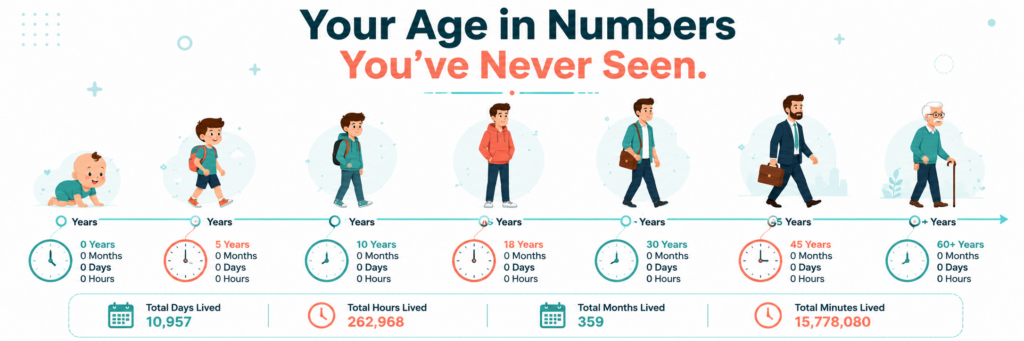
When a calculator tells you that you've lived 245,000+ hours, it's easy to scroll past that number without pausing. But those numbers are worth sitting with for a moment, because they reframe how you understand your own life.
A 30-year-old person has lived approximately 10,950 days. That's 262,800 hours. During that time, their heart has beaten roughly 1.15 billion times. They've taken somewhere around 630 million breaths. These aren't trivial statistics - they're a different lens through which to see time, and many people find it genuinely motivating or humbling.
From a more practical angle, age in time is meaningful across different cultures and systems. In the traditional Indian system, a child's age is often considered to begin at conception rather than birth, making the child approximately 9 months "older" than the birth certificate suggests. In the Korean age system, everyone is considered one year old at birth and everyone gains a year on January 1st rather than on their birthday - so a Korean age is typically one or two years higher than the international standard.
The age calculator with time that you use online follows the internationally accepted method: counting from the exact birth date and time to the present moment. This is the standard used in legal documents, medical records, and government databases across India and globally.
Why Knowing Your Exact Age Matters
It might seem like age is something you carry in your head and never really need to verify. But the reality is that precise age - down to the month and day - determines eligibility, access, and benefits across dozens of categories in Indian life.
Competitive exam eligibility is perhaps the most common reason people search for an exact age calculator. Exams like UPSC, SSC CGL, IBPS PO, and state PSC exams all have age cutoffs - and these cutoffs are calculated as of a specific date, not as of January 1st of the year. If the cutoff date is July 1st and you turn 27 on July 10th, you're still eligible. But if you turn 27 on June 28th, you've crossed the limit. Getting this wrong costs you an attempt.
Government scheme eligibility under programs like PM Kisan, Pradhan Mantri Vaya Vandana Yojana, Atal E-Sewa Kendra, Ayushman Card, and various scholarship schemes often requires age verification to a specific threshold. Applicants frequently need to prove they are above or below a certain age as of the date of application.
School and college admissions use age cutoffs as well. Many school boards require a child to be a specific age (often 5 or 6 years as of a particular date) to be admitted to Class 1. Being even a few days short can mean waiting an entire year.
Insurance and financial products calculate premiums based on your exact age at the time of purchase. Many policies use "age last birthday" versus "age nearest birthday" - and knowing which method your insurer uses, and then knowing your precise age, can affect how much you pay.
Retirement and pension planning depends heavily on precise age tracking. The EPF retirement age, the NPS exit rules, and private pension products all trigger based on specific age milestones.
Age Calculator for Different Purposes
The basic function - enter DOB, get age - is just the beginning. A well-designed age calculator with time serves different use cases depending on how you frame the calculation.
Calculating Age for Government Form Submission
When filling forms like passport applications, Aadhaar corrections, or exam registration, the required age is always as of the "cutoff date" mentioned in the notification - not today's date. Use the calculator by setting the target date to that cutoff date. The result gives you your official age for that application, which is the figure that must match what you write in the form.
Age Difference Calculator Between Two People
Many of the same tools include a mode where you enter two dates of birth and calculate the exact age gap between two people. This is commonly used by couples, by siblings comparing notes, or by HR teams running reports. The output isn't just "5 years" - it's 5 years, 2 months, and 17 days, which is the kind of precision needed for certain legal or financial documents.
Calculating a Child's Age for Medical Purposes
Pediatric medicine is especially dependent on precise age. Vaccination schedules, drug dosages, and developmental milestones are all linked to age in months and weeks rather than years during the first five years of life. A child who is 18 months old is at a very different developmental stage than a child who is 23 months old, even though both might be called "almost 2."
Age for Retirement and EPF Calculations
If you're planning retirement or tracking when your EPF account matures, you need to know exactly how many years and months remain until you hit 58 or 60 (depending on your employment category). The age calculator gives you this gap precisely, and some versions also display a countdown to your next major age milestone.
Pet Age Calculator
While slightly different in formula (dogs and cats age faster than humans and don't follow a 1:7 ratio as popularly believed), the same date-based logic applies. Knowing your pet's age in months is critical for vaccination schedules and diet adjustments, and many general age calculators include a pet mode.
How Age Is Calculated – The Math Behind It
Understanding the mathematics behind the calculation helps you trust the result and also explains why different calculators sometimes give slightly different answers.
The core logic works like this: the calculator takes your birth date and subtracts it from the current date. However, the subtraction isn't as simple as subtracting two numbers, because months have different lengths (28, 29, 30, or 31 days), and years have either 365 or 366 days depending on whether they're leap years.
The process unfolds in layers. First, the calculator determines the number of complete years that have passed - this is done by checking whether your current-year birthday has occurred yet. If today is June 10th and your birthday is June 15th, you haven't completed another year yet; your age is still the previous number. If today is June 20th and your birthday was June 15th, the year has completed and your count goes up.
After establishing full years, the calculator then computes the remaining months by checking how many full calendar months have passed since your last birthday. Then it counts the remaining days after the last complete month. Finally, if birth time is included, it computes the remaining hours and minutes.
Leap year handling is a specific edge case. February 29th birthdays are the classic example - in non-leap years, most calculators count the birthday as either February 28th or March 1st, and different tools handle this differently. A well-built calculator will clearly document which convention it follows.
Time zone differences matter for birth times. If you were born in India (IST, UTC+5:30) and you're using a calculator that operates in UTC, there's a 5.5-hour offset to account for. Quality tools either ask for your timezone or automatically detect it. For general purpose use this rarely matters, but for very precise calculations around midnight births, it does.
Conclusion
An age calculator with time is one of those quietly powerful tools that most people underestimate until they actually need precision. Whether you're verifying exam eligibility, understanding a medical requirement, planning retirement, or simply satisfying curiosity about how many days you've been alive, the tool delivers a kind of clarity that a rough mental calculation never can.
The calculation itself has more nuance than it appears — leap years, birth times, timezone offsets, and month-length variations all play a role in the final number. A well-built age calculator handles all of that in the background so you get a reliable result instantly.
Use the Age Calculator with Time on this page to find your exact age right now — no signup, no wait, and no approximations. Just your real age, down to the hour.
It is an online tool that calculates your exact age in years, months, days, hours, and minutes using your birth date.
Yes, most online age calculators are completely free to use.
Yes, you can use a date of birth calculator online to calculate your age instantly.
Yes, a good exact age calculator gives highly accurate results.
Yes, students often use age calculators for school admissions and exam forms.
Yes, advanced tools can show your age in hours, minutes, and seconds.
Enter your date of birth in the calculator and set the target date to the official age cutoff date mentioned in the exam notification - not today's date. The result will show your exact age as of that cutoff, which is the figure that matters for eligibility.
Yes, any reliable age calculator accounts for leap years, including February 29th birthdays. The tool adjusts day counts automatically so that leap year differences don't skew the result.