
Career Benefits of a PhD for Working Professionals
Today, in an ever-competitive labor market, professionals are always on the lookout for ways to increase their specialty, enhance their qualifications, and speed up their careers. A Doctor of Philosophy (PhD) continues to be one of the most elite academic achievements even as certificates and specialized training programs provide skills in their desired areas of specialization.
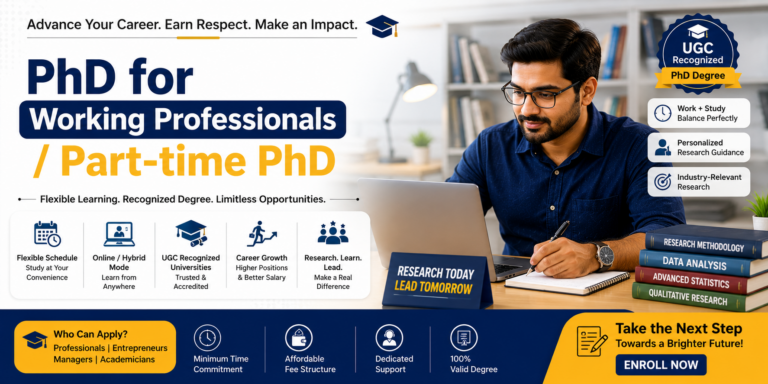
A PhD for working professionals has traditionally been considered an academic, research-based venture, but it is becoming a strategic career path for professionals who work in all areas. It does take time and commitment to complete a PhD alongside a full-time career, but there can be a tremendous long-term payoff. Whether that’s opportunities for leadership and earning more, specialized expertise, or professional recognition, having a doctoral degree can carry significant benefits for career progression. Professionals exploring structured postgraduate options alongside work may also find our guide onOnline MCA Degree – Eligibility, Fees & UGC Validity useful as a starting point before committing to doctoral-level study.
Enhanced Subject Matter Expertise
One of the many advantages that a Part-time PhD offers is the chance of developing deep knowledge in a particular domain. Rather than general concepts in undergraduate programs or master’s programs, which take up topics broadly, doctoral studies encourage practitioners to probe the intricacy of topics, to investigate them deeply and to produce original work; finally, in their area, to contribute something novel that was not done at that time. This highly regarded expertise positions them as industry thought leaders. Whether they are working in healthcare, business, technology, education, or engineering, a PhD holder typically becomes a trusted advisor and expert who can help solve complex company problems. For technology professionals specifically, doctoral-level specialization in emerging fields like cloud infrastructure is becoming increasingly valuable – see how Online MCA in Cloud Computing is shaping this trend at the postgraduate level.
Better Career Opportunities for Advancement
A university doctorate demonstrates the type of analytical, research, and problem-solving skills that are sought after throughout the leadership and strategic sectors. Doctoral-educated professionals are often well-placed to assume high-level roles in senior management, executive management, advisory, or specialized research settings. And that means an advanced education as well – a position for which you cannot just have two years and go nowhere. In some fields, a PhD for working professionals can help distinguish you when fighting for promotions or for leadership positions. With greater utilization of intelligence leadership and innovation, data-driven strategy: For more organizations, we could be trained to adopt more data analysis and innovation for decision-making. People with advanced research ability are going to be able to determine business strategies and the growth of organizations with the potential to shape them. Professionals targeting senior business leadership roles may also consider reading about Top Online MBA Colleges in India as a complementary or alternative pathway to executive advancement.
Increased Revenues
While the need to earn more money should never be the only driver for people to pursue a part-time PhD, research has consistently found that doctors earn a higher salary than people with a bachelor’s degree or their master’s. This specialized degree of knowledge, expertise, and leadership that comes with a doctorate of higher education earns us a job in fields with higher salaries. Health care, pharmaceuticals, technology, finance, and graduate education industries routinely pay high salaries for practitioners with doctoral degrees. The enhanced earning potential can make a significant contribution over a career and represents a return on the investment placed on doctoral education.
Advanced Research and Analytical Skills Development
A Ph.D. program teaches professionals advanced research methods, analytical skills, and critical thinking skills. And these skills are increasingly necessary in the increasingly complex business world where businesses need to make sense of complicated statistics, assess market trends, and make data-driven choices. Highly effective professionals who can research, analyze, and provide actionable insights can actually help employers. They are more equipped to detect opportunities, counter organizational issues, and engage in innovation. The skills of knowledge transfer for research are highly applicable equally to any industry and can indeed improve not only the performance of people performing tasks with more effort – they are also a useful tool in leading technical and managerial teams.
Prestige and Professional Credibility
The postgraduate degree carries a great deal of prestige and respect. The “Doctor” is considered a status of expertise and intellect and is associated with passion, experience, and dedication. For practitioners in consulting, training, healthcare, education, public policy, human resource management, or corporate leadership, a PhD for working professionals can reinforce the credibility of the work one does among clients, peers, employees, stakeholders: their partners, clients, or other stakeholders, or industry leaders. Shows an investment in excellence and the potential for you to make a difference in a field. A better reputation leads to potential for speaking appointments, advisory positions, industry panels, and professional associations.
Broadening the Network Opportunities
Doctoral programs create an extended tapestry of scholars, researchers, industry professionals, and peer practitioners. Many working professionals see their doctorate as a way to access people whom they regard as “influential” in academia. By meeting them in that new intellectual community, it becomes a good and rewarding prospect. Building networks in academic and professional circles has long-term benefits that may be lasting after graduation.
Academic and Teaching Opportunities
For professionals who want to share knowledge and be a role model for the next generation, a part-time PhD leads to further studies. Many universities and colleges require students to earn a doctoral degree in order to hold a faculty position at a research institute or research department or to hold a university or career advisory position. And professionals still working in industry typically try their hand at adjunct teaching positions. By teaching at universities, it helps people build a base for others to aspire to; it can boost their visibility and help in growing future professionals. The merging of industry and academia provides a very unique and precious approach for the students and the colleges.
Personal Growth and Accomplishment
In addition to career success, getting a PhD is an amazing personal achievement! This research helps develop academic rigour, the ability to learn, and promote resilience, discipline, and intellectual growth. Working professionals who complete doctoral programmes commonly report more confidence, better communication skills, and a greater sense of purpose. Whether able to successfully combine work, study, and personal responsibilities is a testament to great resolve and dedication. This type of personal development can, without a doubt, affect leaders’ effectiveness and decision-making abilities and influence general professional success.
Future-Proofing Your Career
As industries progress through technology and automation, and with competition from around the world and global competition, employers seek out professionals capable of both adapting to change and being change agents, to be adaptable and innovate. A PhD for working professionals provides advanced knowledge and research capabilities that enable professionals to thrive in a fast and changing environment. By taking advantage of changing trends to provide them with expertise as well as ideas for new answers, they can handle such industrial disruptions better and take advantage of opportunities now than in the past. Understanding how technology itself is reshaping learning and professional development is equally important – our article on AI in Education explores how artificial intelligence is already changing the way professionals upskill and how institutions are evolving to meet that demand.
FAQs
Yes. Part-time PhD programs offer flexible schedules – weekends, evenings, or online – so you can study without leaving your job.
Typically 5 to 7 years, compared to 3 to 5 years for a full-time PhD, depending on your university and research topic.
Yes. The degree certificate shows no distinction. Both carry the same academic recognition and career credibility.
Yes. PhD holders consistently earn higher salaries than master’s or bachelor’s degree holders, especially in healthcare, technology, finance, and education.
Fix a weekly study schedule, communicate with your employer early, and lean on your supervisor and peer network for consistent support.
Business (DBA), healthcare, technology management, education, engineering, finance, and public policy are the most career-relevant options.
Many employers offer flexible hours or tuition reimbursement for doctoral studies. It’s worth checking your HR policy before applying.
Long-term, yes — higher earning potential, leadership roles, and professional credibility make the investment worthwhile for most professionals.
Conclusion
For workers, the potential is big: opportunities for advancement, leadership training, greater salary potential, and exposure to professional attention. The trip may be taken, but really the rewards tend to outweigh the hard work in the long term. With more and more attention directed towards innovation, research, and strategy, those possessing doctoral backgrounds are well placed to contribute and prosper in a meaningful way over time. To those aspiring to grow their expertise and horizons in a professional capacity, doing a part-time PhD can be one of the most valuable investments that one can invest on their future.